
EP. 01 - Immersive Expeditions: Redefining Location-Based VR Entertainment
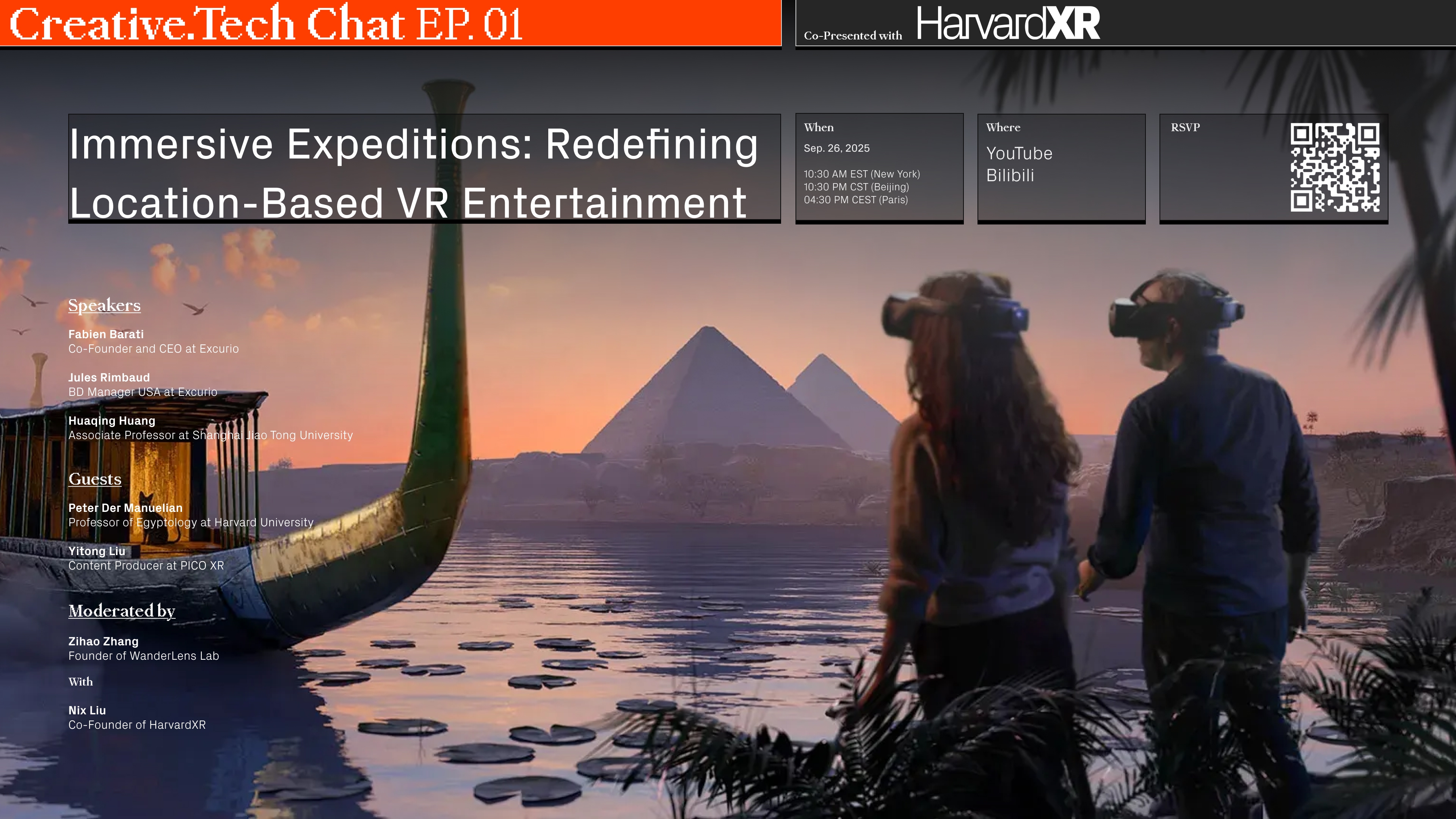
The inaugural Creative.Tech Community Chat spotlights the future of Location-Based VR. Excurio, creators of the acclaimed Horizon of Khufu, share the story of Immersive Expeditions, while Professor Huaqing Huang discusses LBVR projects in China and their role in cultural heritage. A roundtable with Harvard Egyptologist Peter Der Manuelian and PICO XR’s Yitong Liu explores pipelines, market strategies, and the power of interdisciplinary collaboration in immersive entertainment.






Horizon of Khufu and the Future of Space
A Global Dialogue on LBVR from Paris to Harvard
Creative Tech Chat Series | Feature StoryBy Creative.Tech
In the premiere of the Creative.Tech Chat Series, creators and scholars from Paris, Shanghai, and Harvard gathered to discuss how Location-Based Virtual Reality (LBVR) is transforming the way we experience culture, education, and space. The conversation—moderated by Nix Liu Xin (HarvardXR co-founder, Creative.Tech editor-in-chief) and Zihao Zhang (WanderLens Lab founder, Creative.Tech curator)—offered a rare look at the creative and technological infrastructures behind today’s most ambitious immersive projects.

Excurio: Crafting Immersive Expeditions and Building the Infrastructure Behind Them
Representing the French immersive studio behind Horizon of Khufu, Fabien Barati (CEO & Co-Founder) and Jules Ringbald (U.S. Development Lead) discussed how LBVR has evolved from experimental VR into a cultural format.
“We started as a studio specialized in VR and AR, working with cultural institutions and luxury brands.” —Fabien Barati
Excurio now defines their work not as installations, but as “immersive expeditions”—shared experiences grounded in history, archaeology, and emotional storytelling rather than purely technical spectacle.
“Content is king. We work with the world’s top museums—from the Musée d’Orsay to Harvard—combining scientific accuracy with emotional storytelling.” —Jules Ringbald
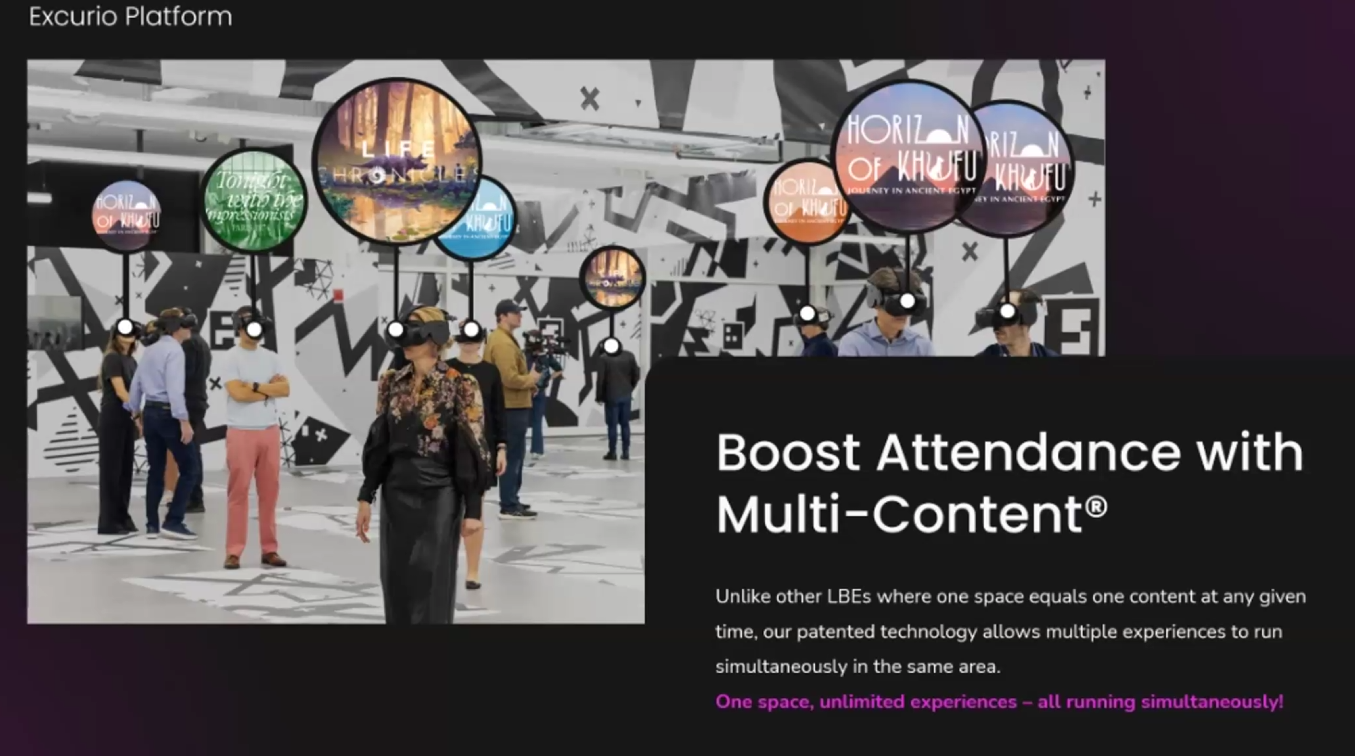
The studio is now expanding from production to infrastructure: the Exko Platform, built to support multi-user navigation, spatial mapping, and museum-grade reliability, will become accessible to external creators.
Today, Horizon of Khufu is operating in more than 25 cities worldwide, signaling a shift from one-off experiences to a scalable cultural ecosystem.
Peter Der Manuelian (Harvard University): VR as Scholarly Infrastructure
As director of the Giza Project, Professor Peter Der Manuelian contributed to Horizon of Khufu as an academic advisor—ensuring historical fidelity throughout the reconstruction.
“It’s a balancing act—from the costumes to the architecture, there are endless ways to make mistakes.”
For Peter, VR is not a replacement for monuments, but a complementary learning tool:
“These models let us teach what the real monuments cannot.”
Through immersive simulations such as Harvard Camp, students practice archaeological reasoning: examining artifacts, navigating excavation workflows, and understanding cultural context through embodiment rather than passive observation.
“Everyone is free to wander, but there’s still a linear story. It’s a balance between freedom and guidance.”

Huaqing Huang (Shanghai Jiao Tong University): Architecture as a cultural narrative
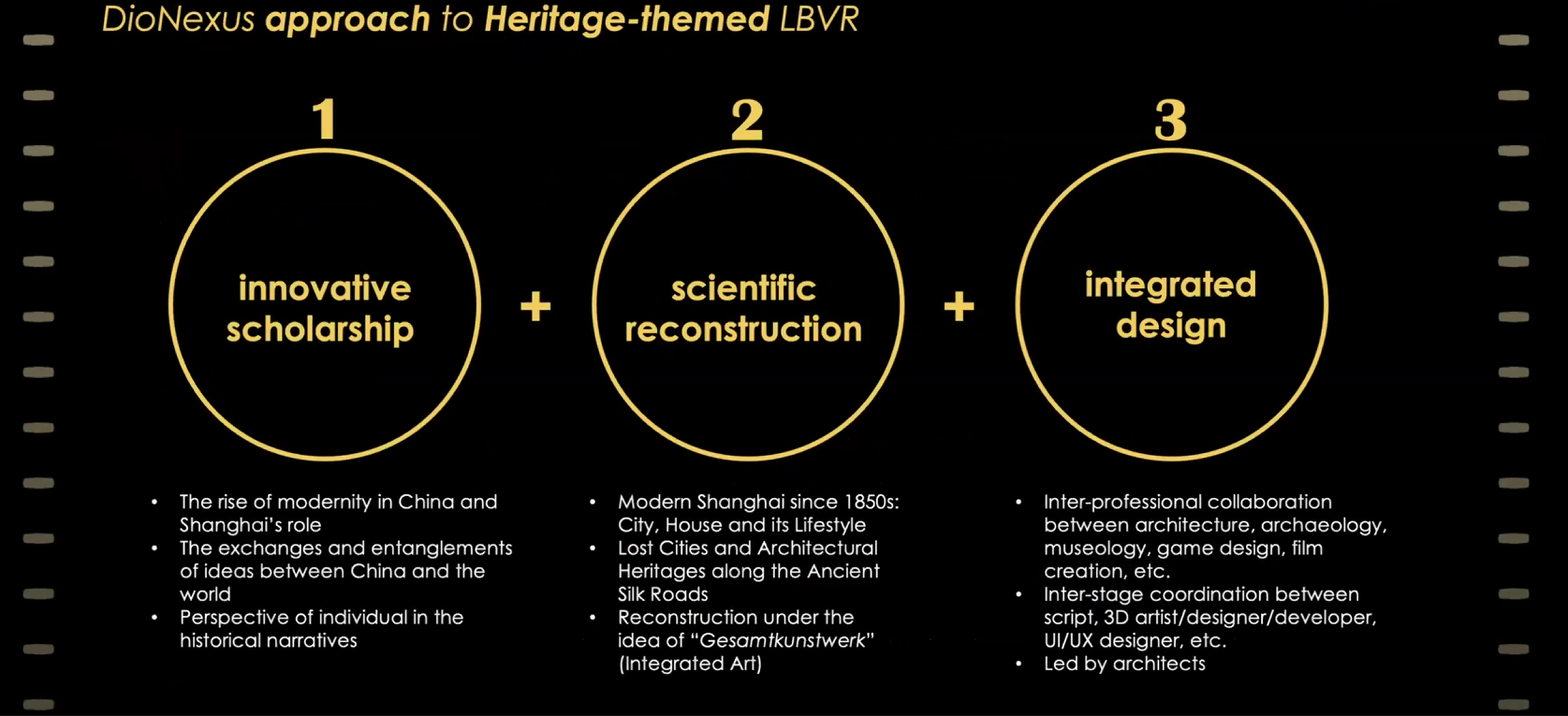
Professor Huaqing Huang, co-founder of Dianaxis and lead creator of Shanghai 1924, approaches LBVR as a long-form architectural medium—one where virtual environments are not only visually reconstructed, but socially and culturally situated.
“The sense of immersiveness, the sense of spectacle, and the sense of authenticity—these are the three pillars of an LBVR experience.”
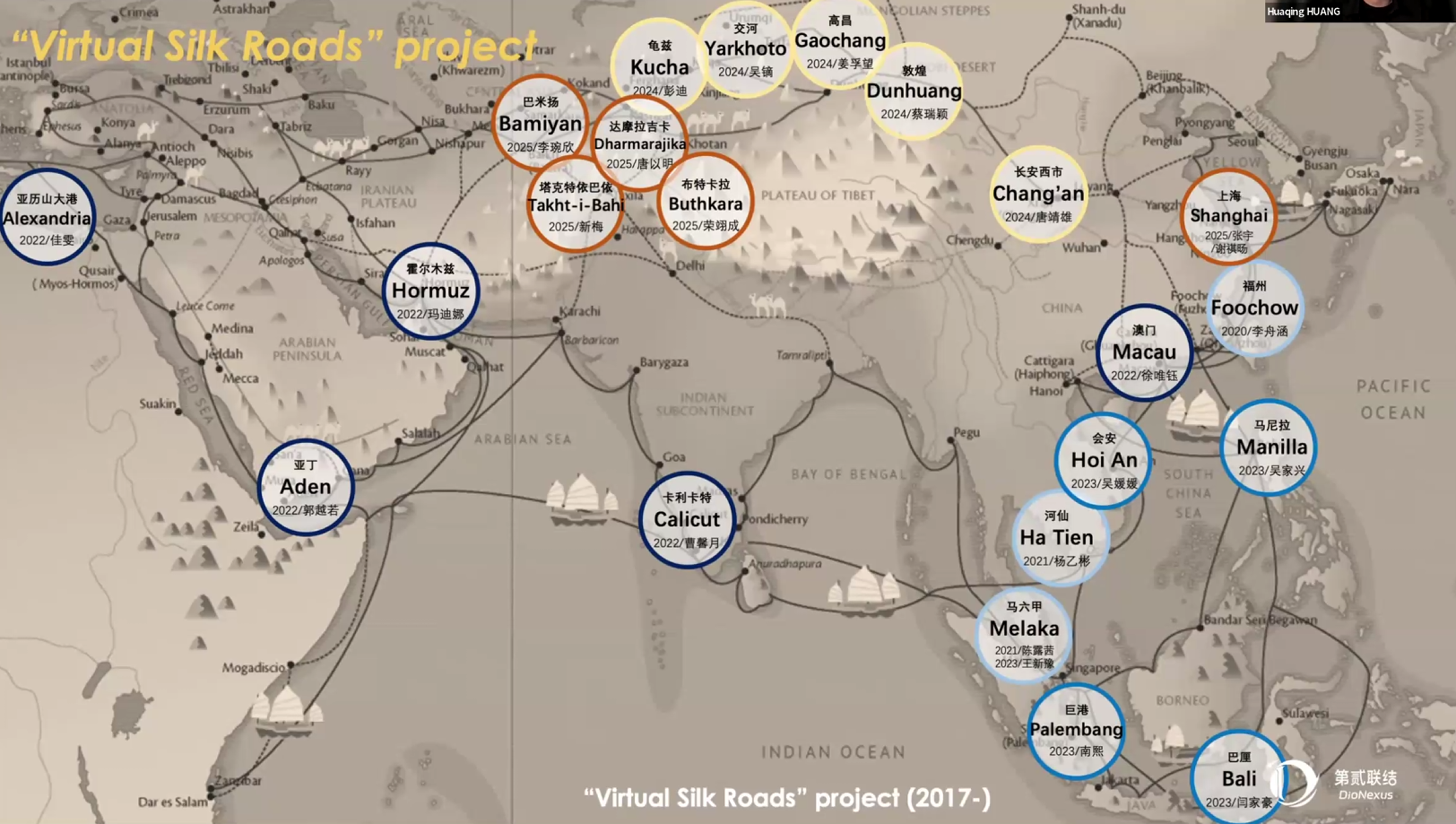
Unlike traditional VR content, LBVR requires thinking in systems, workflows, and spatial behaviors. Huang spoke extensively about the upstream–downstream ecosystem: archives, scanning, modeling, engine development, narrative design, platform deployment, audience testing, and site-specific adaptation.
As an architect, he sees his role as designing:
- Circulation systems, not just models
- Narrative pacing, not just scenes
- Human behavior in space, not just visual fidelity
“The audience is also a user—they must be designed into the spatial narrative.”
He describes works like Shanghai 1924 as virtual urban dramas—where cultural memory, architecture, and embodied interaction converge.
Yitong Liu (PICO XR): Hardware and Operational Realities
From the device side, Yitong Liu (PICO XR) highlighted the enabling role of hardware evolution—lighter headsets, stable tracking, and multi-user synchronization are essential for LBVR to function in public cultural institutions.
Her perspective underscored an emerging technical alignment: LBVR succeeds when narrative ambition, spatial design, and hardware capability operate together rather than separately.
Looking Ahead
From Paris’s Horizon of Khufu to Shanghai 1924 and Harvard’s virtual pyramids, LBVR is evolving into a layered medium—combining research, architecture, spatial computing, and public storytelling.
Rather than watching history, audiences now enter it—walking, listening, wandering, and remembering within shared virtual space.